Mortgage Deferrals Now Recorded on Credit Reports

Jen & Cory • August 11, 2020
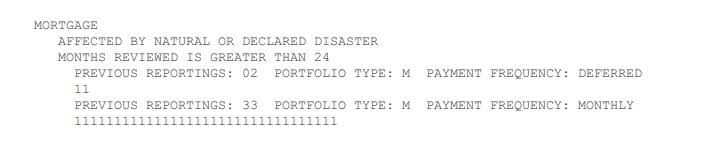
If COVID-19 has negatively impacted your finances and you're currently deferring your mortgage payments, you should know that this will be visible on your credit report. Here is an image from a recent credit report.

In this scenario, it shows that the mortgage was paid as agreed monthly for 33 months before being deferred for the last two months. It also shows that mortgage payments are currently in deferral.


Some may consider the credit bureau reporting a deferred status as good news. As COVID-19 hit like a freight train, many financial experts wondered about reporting errors on credit bureaus as a result of deferred payments. The fact that there is a system in place to report deferrals is a good sign.


Deferring your mortgage payment won't lower your credit score, but reporting errors from deferrals might. Once you've resumed your payments, it's a good idea to get a copy of your credit report to check for errors.


So, why does this matter to me now?


If you're considering a change to your mortgage, most lenders will be very hesitant to consider lending you new money when you aren't able to make your existing mortgage payments. This will be the case if you are looking to purchase a new property, renew, or refinance your current mortgage.


In fact, some lenders expect to see a history of regular repayment on any previously deferred loans before proceeding with any new application. Length of time after deferral varies by lender. This would include any debt payments (loan, line of credit, credit card) that have been deferred as well.


If changes to your mortgage are on the horizon, you need to have resumed all your regular debt payments before it will be possible to secure new mortgage financing.


If you'd like to discuss your personal financial situation with us, please contact us anytime!

Jen & Cory
YOUR MORTGAGE EXPERTS

CONTACT US
Recent Posts

By Jen & Cory January 28, 2026
Bank of Canada maintains policy rate at 2¼%. FOR IMMEDIATE RELEASE Media Relations Ottawa, Ontario January 28, 2026 The Bank of Canada today held its target for the overnight rate at 2.25%, with the Bank Rate at 2.5% and the deposit rate at 2.20%. The outlook for the global and Canadian economies is little changed relative to the projection in the October Monetary Policy Report (MPR). However, the outlook is vulnerable to unpredictable US trade policies and geopolitical risks. Economic growth in the United States continues to outpace expectations and is projected to remain solid, driven by AI-related investment and consumer spending. Tariffs are pushing up US inflation, although their effect is expected to fade gradually later this year. In the euro area, growth has been supported by activity in service sectors and will get additional support from fiscal policy. China’s GDP growth is expected to slow gradually, as weakening domestic demand offsets strength in exports. Overall, the Bank expects global growth to average about 3% over the projection horizon. Global financial conditions have remained accommodative overall. Recent weakness in the US dollar has pushed the Canadian dollar above 72 cents, roughly where it had been since the October MPR. Oil prices have been fluctuating in response to geopolitical events and, going forward, are assumed to be slightly below the levels in the October report. US trade restrictions and uncertainty continue to disrupt growth in Canada. After a strong third quarter, GDP growth in the fourth quarter likely stalled. Exports continue to be buffeted by US tariffs, while domestic demand appears to be picking up. Employment has risen in recent months. Still, the unemployment rate remains elevated at 6.8% and relatively few businesses say they plan to hire more workers. Economic growth is projected to be modest in the near term as population growth slows and Canada adjusts to US protectionism. In the projection, consumer spending holds up and business investment strengthens gradually, with fiscal policy providing some support. The Bank projects growth of 1.1% in 2026 and 1.5% in 2027, broadly in line with the October projection. A key source of uncertainty is the upcoming review of the Canada-US-Mexico Agreement. CPI inflation picked up in December to 2.4%, boosted by base-year effects linked to last winter’s GST/HST holiday. Excluding the effect of changes in taxes, inflation has been slowing since September. The Bank’s preferred measures of core inflation have eased from 3% in October to around 2½% in December. Inflation was 2.1% in 2025 and the Bank expects inflation to stay close to the 2% target over the projection period, with trade-related cost pressures offset by excess supply. Monetary policy is focused on keeping inflation close to the 2% target while helping the economy through this period of structural adjustment. Governing Council judges the current policy rate remains appropriate, conditional on the economy evolving broadly in line with the outlook we published today. However, uncertainty is heightened and we are monitoring risks closely. If the outlook changes, we are prepared to respond. The Bank is committed to ensuring that Canadians continue to have confidence in price stability through this period of global upheaval. Information note The next scheduled date for announcing the overnight rate target is March 18, 2026. The Bank’s next MPR will be released on April 29, 2026. Read the January 28th, 2026 Monetary Report
By Jen & Cory January 21, 2026
For most Canadians, buying a home isn’t possible without a mortgage. And while getting a mortgage may seem straightforward—borrow money, buy a home, pay it back—it’s the details that make the difference. Understanding how mortgages work (and what to watch out for) is key to keeping your borrowing costs as low as possible. The Basics: How a Mortgage Works A mortgage is a loan secured against your property. You agree to pay it back over an amortization period (often 25 years), divided into shorter terms (ranging from 6 months to 10 years). Each term comes with its own interest rate and rules. While the interest rate is important, it’s not the only thing that determines the true cost of your mortgage. Features, penalties, and flexibility all play a role—and sometimes a slightly higher rate can save you thousands in the long run. Key Questions to Ask Before Choosing a Mortgage How long will you stay in the property? Your timeframe helps determine the right term length and product. Do you need flexibility to move? If a work transfer or lifestyle change is possible, portability may be important. What are the penalties for breaking the mortgage early? This is one of the biggest factors in the real cost of borrowing. A low rate won’t save you if breaking costs you tens of thousands. How are penalties calculated? Some lenders use more borrower-friendly formulas than others. It’s not easy to calculate yourself—get professional help. Can you make extra payments? Prepayment privileges allow you to pay off your mortgage faster, potentially saving years of interest. How is the mortgage registered on title? Some registrations (like collateral charges) can limit your ability to switch lenders at renewal without extra costs. Which type of mortgage fits best? Fixed, variable, HELOCs, or even reverse mortgages each have their place depending on your financial and life situation. What’s your down payment? A larger down payment could reduce or eliminate mortgage insurance premiums, saving thousands upfront. Why the Lowest Rate Isn’t Always the Best Choice It’s tempting to chase the lowest rate, but mortgages with rock-bottom pricing often come with restrictive terms. For example, saving 0.10% on your rate may put a few extra dollars in your pocket each month, but if the mortgage has harsh penalties, you could end up paying thousands more if you break it early. The goal isn’t just the lowest rate—it’s the lowest overall cost of borrowing . That’s why it’s so important to look beyond the headline number and consider the whole picture. The Bottom Line Mortgage financing in Canada is about more than rate shopping. It’s about aligning your mortgage with your financial goals, lifestyle, and future plans. The best way to do that is to work with an independent mortgage professional who can walk you through the fine print and help you secure the product that truly keeps your costs low. If you’d like to explore your options—or review your current mortgage to see if it’s really working in your favour—let’s connect. I’d be happy to help.